
Blogs
From Engineer to Enoch’s Scribe: Jeffery O. Brown’s Unexpected Path to Restoring Ancient Prophecy

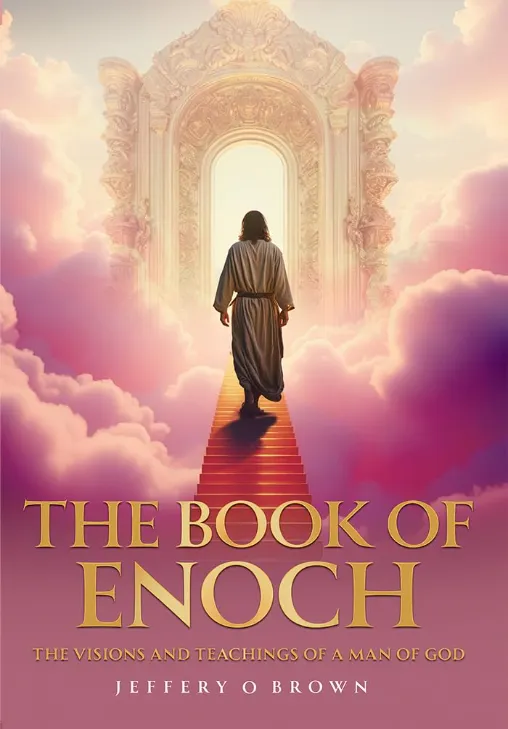
It is late at night in 1997. The internet is still new, filled with scattered archives and early digital libraries. A biomedical engineer scrolls through obscure religious texts, not searching for anything specific, just following a line of curiosity. Most of what he finds feels incomplete. Then he comes across a name that has survived for centuries but never fully explained itself.
The Book of Enoch.
At first, the interest is technical. The structure seems inconsistent. The tone shifts. Sections feel incomplete. For Jeffery O. Brown, the problem is not theological. It is structural. The text looks like something that has been edited, altered, and reduced over time.
The observation becomes the starting point.
A Problem Approached Like a System
Brown’s background is in biomedical engineering. His work involved building and refining complex systems, often with incomplete data. In that world, fragments are not ignored. They are examined. Patterns are identified. Missing pieces are inferred.
When he reads the Book of Enoch, he applies the same logic.
The commonly available version, known as 1 Enoch, has long been debated. Scholars point to multiple authors and layers of editing, often dating the text to centuries after the time it describes. The result is a record that feels uneven, more like a compilation than a unified work.
Brown’s conclusion is straightforward. If the current text shows signs of fragmentation, it may not represent the original record in full.
This raises a practical question. If something has been reduced, can it be partially rebuilt?
The Shift from Reading to Reconstruction
What begins as curiosity turns into a process. Brown starts gathering material from multiple sources. Biblical references to Enoch provide a baseline. Apocryphal writings add detail, though often inconsistently. Other ancient texts offer fragments that may connect to the same narrative.
He also turns to Latter-day Saint scripture, particularly the Book of Moses, which contains extended material about Enoch that does not appear in the traditional biblical account.
The goal is not comparison for its own sake. It is alignment. Where do these texts overlap? Where do they diverge? And more importantly, where do they suggest something missing?
Brown treats the problem the way an engineer treats a damaged structure. The existing pieces are studied not just for what they say, but for what they imply.
A Turning Point
As the work progresses, the nature of the project changes. It is no longer just research. Brown begins to question whether the effort itself has a direction beyond analysis.
In early April 1997, during a period of sustained study and reflection, he experiences what he later describes as a decisive moment. He interprets it as a form of spiritual confirmation that the work should continue, but with greater focus and intent.
From that point forward, the project becomes more structured.
Brown organizes his approach around three sources. The Ethiopic text provides one layer of content. Latter-day Saint scripture provides another. The remaining material, he explains, comes through what he understands as guided insight, shaping how the fragments fit together.
Reframing Enoch’s Role
The result is not presented as a definitive restoration. Brown is clear that large portions of the original material may still be missing. What his work attempts to do is expand the role of Enoch from a brief biblical reference into a central figure within a broader narrative.
In this reconstruction, Enoch is not simply a prophet who appears briefly and disappears. He becomes a teacher operating in a complex society, one facing internal instability, competing influences, and gradual moral decline.
Instead of a distant religious account, the narrative begins to resemble a case study. A society forms, develops internal pressures, and eventually collapses under the weight of its own structure.
Why the Story Connects
The relevance of that framework is difficult to ignore.
Modern societies are increasingly focused on questions of transparency, institutional control, and the balance between individual agency and centralized power. In recent geopolitical developments, even nation-states are navigating similar tensions, positioning themselves between competing powers while trying to maintain stability.
In Brown’s reconstruction of Enoch’s world, those same themes appear in a different form. Power becomes concentrated. Influence operates behind the scenes. Individual decision-making weakens as larger structures take control.
The language may differ, but the pattern is recognizable.
An Unusual Convergence
Brown’s path into this subject is what gives the project its distinct angle. He does not approach Enoch as a historian or a theologian. He approaches the text as a system that appears incomplete.
This unique perspective shapes both the structure and the tone of the work. The emphasis is on clarity, alignment, and internal consistency rather than literary style. Brown himself has acknowledged that writing is not his primary discipline. His focus remains on organizing ideas into a coherent framework.
The result is a book that sits between categories. It is not strictly academic. It is not purely devotional. It reflects a process that combines analysis with interpretation.
A Project Defined By One Question
The origin of the work can be traced back to a single moment and a single question.
If the original Book of Enoch once existed in a more complete form, is it possible that parts of it still survive across different sources?
Everything that follows comes from attempting to answer that question.
Brown’s transition from engineer to author was not planned. It developed step by step, driven by a method he already understood. Examine the fragments. Identify the structure. Rebuild what can be rebuilt.
Whether readers accept the conclusions or not, the process itself is clear.
A technical problem met an ancient text, and instead of being left unresolved, it was pursued.
To explore the result of that effort, read The Book of Enoch: The Visions and Teachings of a Man of God by Jeffery O. Brown or visit jefferyobrown to learn more.